
Jefferson County Release Date Types
Georgia state records use more than one future-date concept. The maximum release date, or MRD, is the longest time a person can remain in prison under the court sentence unless a lawful change applies. The Tentative Parole Month, or TPM, belongs to the State Board of Pardons and Paroles. It identifies a month for final parole review. It is not a promise that release will occur in that month.
The actual release date is historical. It records when custody ended at that agency. A local jail release date may result from bond, dismissal, time served, transfer, a lifted hold, or another court action. That date does not prove that the entire case or sentence ended. A transfer to GDC, another county, federal custody, or immigration custody can appear as a local release while the person remains confined elsewhere.
| Date or status | What it means | Primary source |
|---|---|---|
| Maximum release date | Longest state-prison term under the sentence, subject to lawful changes | GDC |
| Tentative Parole Month | Month for final Board review, not a guaranteed exit date | Parole Board |
| County jail release | End of the Jefferson County Jail custody event | Sheriff and court |
| Actual state release | Recorded departure from GDC custody | GDC inactive record |
Find Jefferson County Release Dates
The correct lookup begins with custody type. The Jefferson County Jail handles local arrests, pretrial detention, misdemeanor terms, and holds. Jefferson County Correctional Institution also houses people connected to GDC custody. Similar Louisville facility names can lead to the wrong record system, so confirm whether the person has a GDC identification number before relying on a projected state date.
- For a local detainee, call the Jefferson County Jail at 478-625-7077 and ask whether the person is still held.
- Check the Jefferson County court record for bond, dismissal, sentence, revocation, or transfer orders that control release.
- For a state offender, open GDC Find an Offender, accept the disclaimer, and search by name or ID.
- Compare active and inactive results. “Only Inactive Offenders” means not currently incarcerated in the GDC form.
- Use the Board TPM lookup only for parole timing, then confirm any actual release through GDC.
GDC says its public search can show facility, charges, and release date. A written verification can be requested from Inmate Records and Information, P.O. Box 1529, Forsyth, GA 31029. The agency's disclaimer warns against assuming that a public result is complete.
The official query screen shown below includes name, ID, institution, active or inactive scope, and sentence-status choices. Open the GDC offender query for the live result.
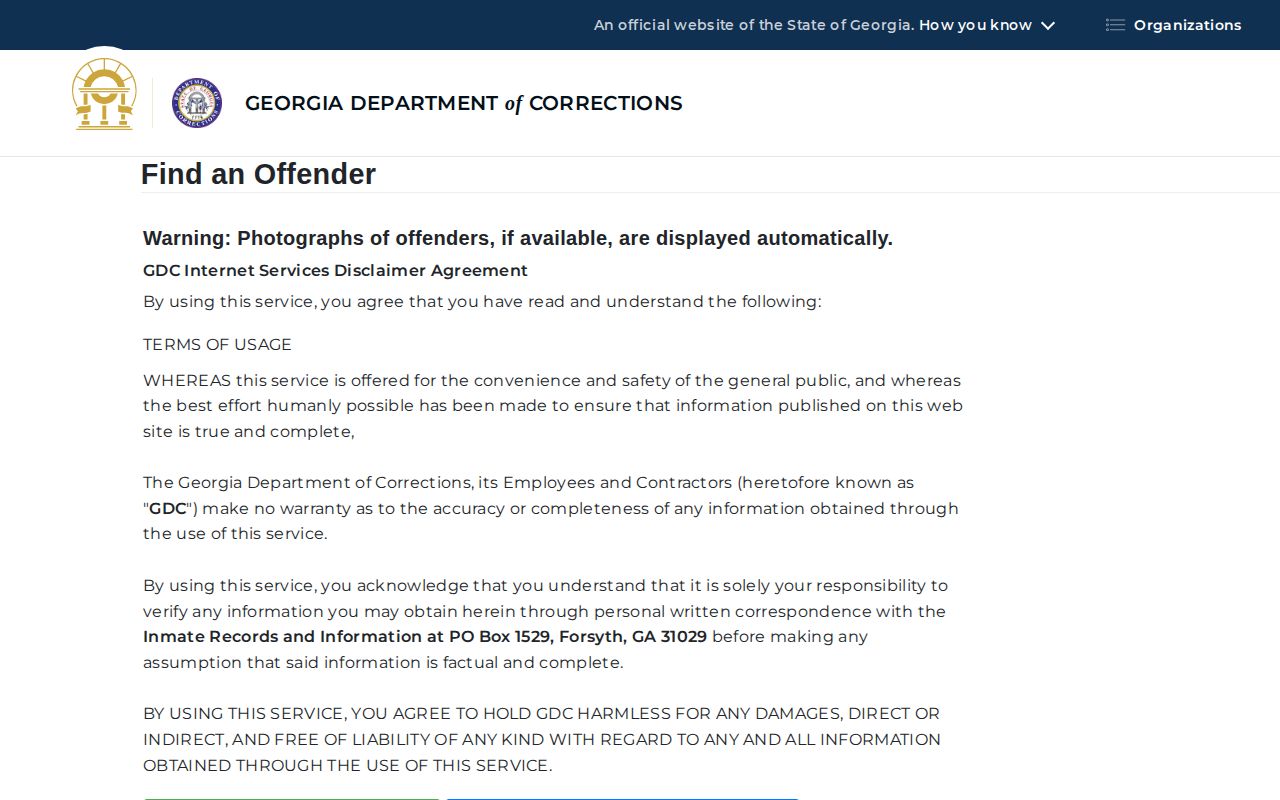
The “Released In The Past 15 Days” choice covers state offenders. It is not a Jefferson County Jail recent-release list.
Jefferson County Jail Date Limits
A pretrial detainee has no sentence-based release date. Release may occur when bond is posted, charges are dismissed, a judge orders release, an agency hold is removed, or transfer takes place. The Jefferson County inmate handbook describes cash, property, professional, and transfer or out-of-county bonds. None creates a reliable public countdown on the county website.
The county does not publish a local jail good-time formula in the sources reviewed. Do not apply a state-prison credit rule to a jail sentence. For a local term, ask the sentencing court, sheriff records staff, or the Jefferson County Clerk of Superior Court to explain the controlling sentence and credit record. The clerk's criminal case file may contain the bond order, disposition, sentencing order, or revocation order that explains a change.
The sheriff's Records Division can be reached at 478-625-7538. A focused request should include the booked name, date of birth, approximate booking date, and case number if known. Ask for the release date and time, release reason, bond or transfer entry, and the record that contains those fields.
Georgia Credits Change Release Dates
Georgia does not support a universal claim that every state prisoner serves a fixed 85 percent. The sourced framework uses MRD, TPM, the Performance Incentive Credit Program, mandatory minimums, and offense-specific limits. A projected Jefferson County inmate release date must be read in that state context.
O.C.G.A. 42-5-101 authorizes work incentive credits for academic or vocational gains, satisfactory work, and compliance with behavior standards. GDC's Performance Incentive Credit Program says eligible offenders can earn up to twelve points and may receive one to twelve months off a TPM or MRD. Case-plan work, education or vocational gains, and work assignments are the three stated paths. Overall good conduct matters because disruptive behavior can delay progress.
The PIC source has firm exclusions. People under a death sentence, those with terms of two years or less, non-parole-eligible or mandatory-minimum offenses, and people serving life sentences are among the excluded groups described by GDC. Eligibility for consideration also does not guarantee a credit.
The state PIC page pictured below explains how credits can affect release calculations. View the current GDC program page for agency wording.
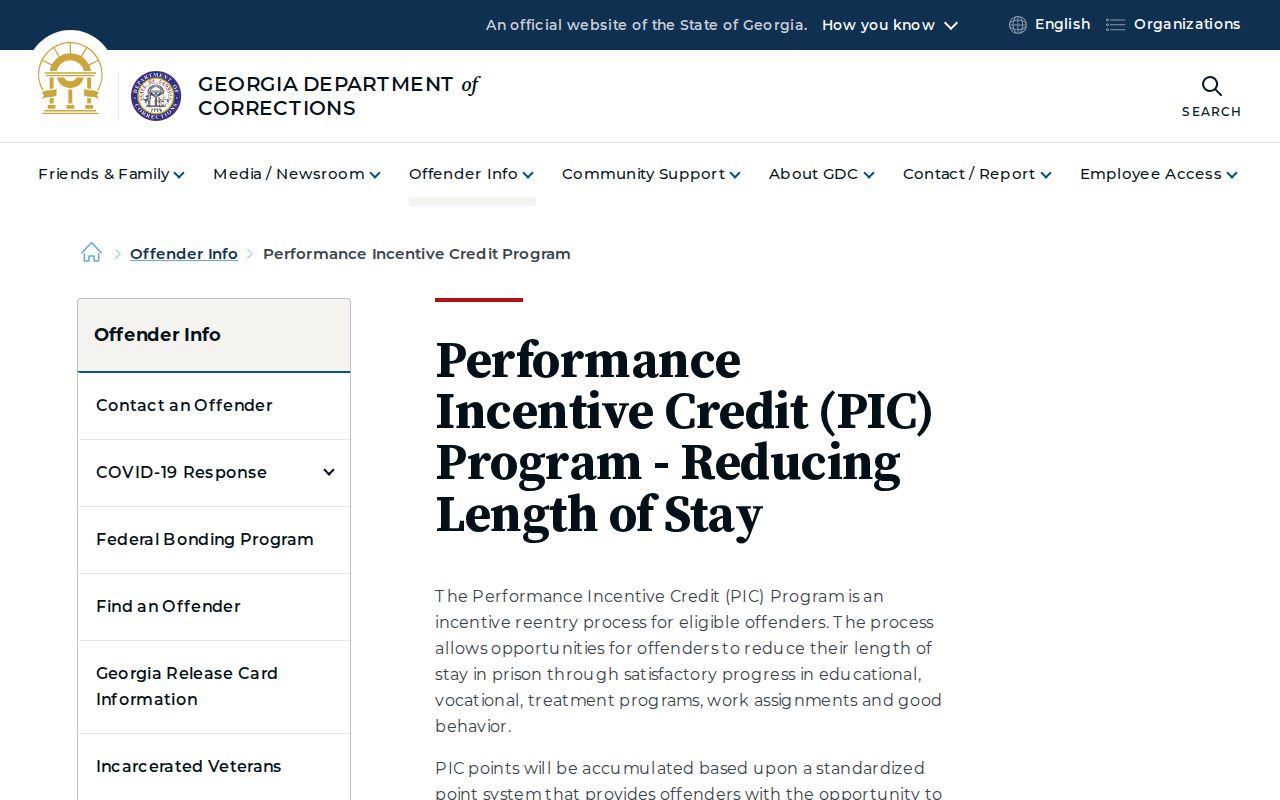
This program applies to eligible state offenders, not to every person held in Jefferson County Jail.
Jefferson County Sentence Restrictions
Older “good time” assumptions can be wrong. O.C.G.A. 42-5-100 ended older earned-time allowances for crimes committed on or after January 1, 1984. O.C.G.A. 17-10-6.1 restricts parole and sentence reductions for serious violent felonies and mandatory minimum terms. Certain minimum terms cannot be cut by earned time or other GDC programs.
Life-sentence parole eligibility also depends on the offense date and law. The Board's process materials describe seven-year eligibility for qualifying pre-1995 cases, fourteen years after 1995 changes, and thirty years for covered crimes committed on or after July 1, 2006. These are eligibility points, not automatic release dates.
- MRD
- Maximum release date, the longest state-prison time under the sentence.
- TPM
- Tentative Parole Month, a final-review month that may change.
- PIC
- Performance Incentive Credit that may reduce an eligible offender's MRD or TPM.
- Mandatory minimum
- A term the law requires without the ordinary reductions.
Why Jefferson Release Dates Move
A public date is a snapshot. GDC misconduct reports can postpone or cancel a TPM. Program completion and PIC eligibility can alter a calculation. A court can amend an order. A bond can be posted or revoked. Another agency may add or lift a detainer, which is a request to hold or transfer a person.
| Change | Possible effect | Who controls it |
|---|---|---|
| Misconduct report | TPM postponement or cancellation | GDC and Parole Board process |
| PIC progress | Potential MRD or TPM reduction | GDC and Board rules |
| Court order | Release, resentencing, revocation, or transfer | Sentencing court |
| Bond change | Earlier release or renewed custody | Court and jail |
| Detainer | Continued hold or agency transfer | Requesting and holding agencies |
| Parole plan review | Approval, delay, denial, or final date | Parole Board |
A TPM can exist without release. The Board information page pictured below explains that status. Open the TPM source page before using the lookup.
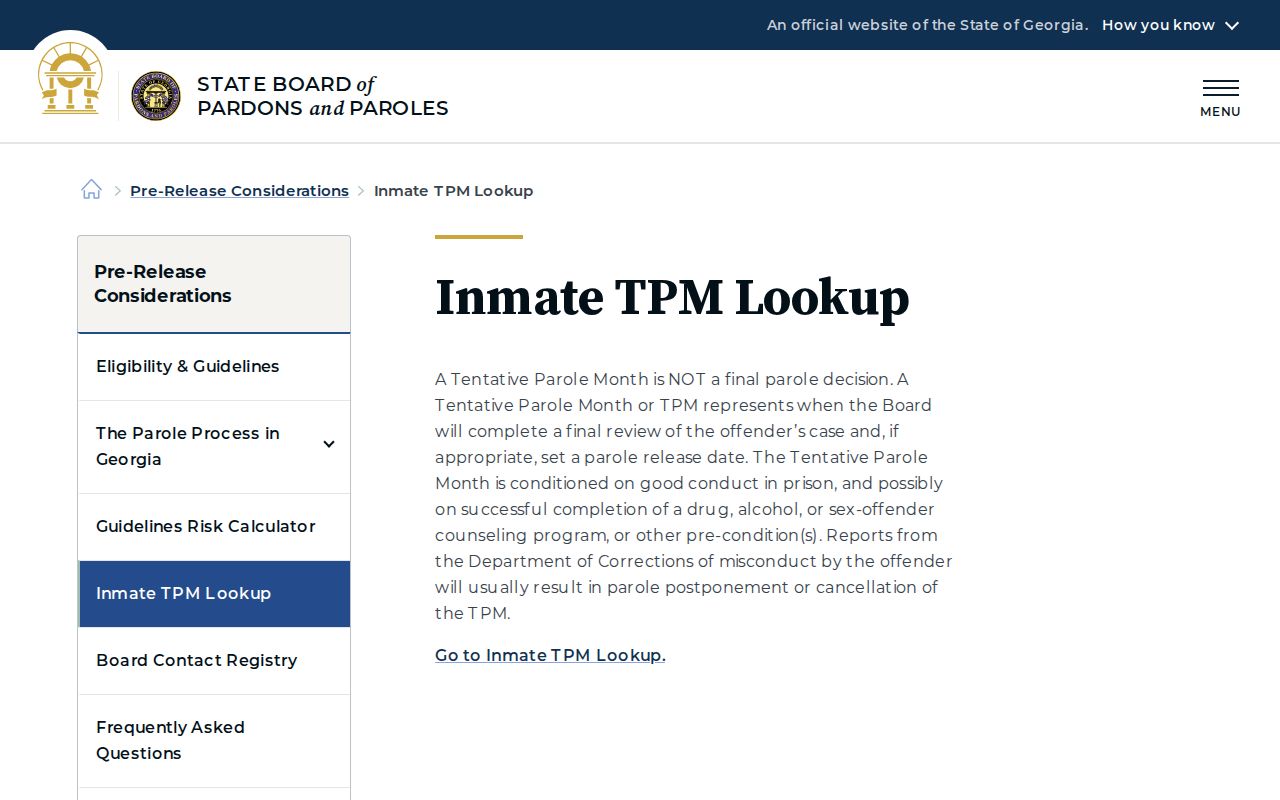
Compare that parole marker with the GDC record instead of merging them into one date.
Confirm Jefferson County Release
Identity checks matter before relying on any projected date. A GDC ID, also called a UNO, is the strongest public identifier in the state query. A case number can help too, though one person may have several case numbers. With a name search, compare date of birth, conviction county, most recent institution, and case details. A common name alone is not enough to connect a date to a person.
The record scope also changes the answer. “Only Active Offenders” focuses on people currently incarcerated. “Only Inactive Offenders” is labeled as not currently incarcerated. Searching both is the safest first pass when status is uncertain. The “Released In The Past 15 Days” filter covers recent state releases, not local jail-only detainees.
Near the expected date, check the controlling agency again. For a local jail release, call the jail and review the court order. For state prison, compare the GDC status and the Board record. A person who changes from active to inactive in GDC may have been released, but the individual record and written verification provide stronger context.
VINELink Release Check can supply a custody-change alert when the person and facility participate. It is a notification tool, not a permanent sentence calculator. A VINE alert confirms a change in the feeding agency, not the end of all court, parole, probation, registry, federal, or immigration obligations.
The Jefferson County released-inmate lookup combines jail, court, GDC, parole, federal, and immigration paths. Use it when a local “release” may really mean transfer to another custodian.